1599: A Year in the Life of Shakespeare by James Shapiro
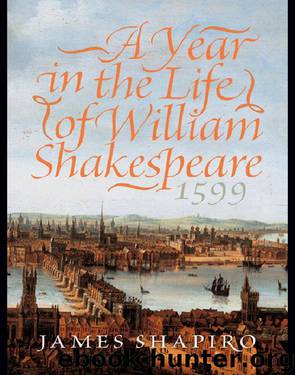
Author:James Shapiro
Language: eng
Format: mobi
ISBN: 9780061840906
Publisher: HarperCollins
Published: 0101-01-01T00:00:00+00:00
THE PUBLICATION OF THE PASSIONATE PILGRIM WOULD AMOUNT TO LITTLE more than a footnote to his career if not for the impact it had upon Shakespeare’s thinking about his stolen sonnets, about Marlowe and the pastoral, and, through both, about As You Like It. After it appeared as the opening poem in The Passionate Pilgrim, Shakespeare went back to “When My Love Swears That She Is Made of Truth” and changed it. The copy Jaggard had got hold of may have introduced a few errors, but the difference between the two versions (especially when compared with the versions of the companion sonnet Jaggard published with it) makes clear that the revisions were Shakespeare’s. While he could have revised it at any time between 1599 and 1609 (when it reappeared in his collected Sonnets), it’s likely that Shakespeare was spurred to make the changes soon after it appeared in print. It’s impossible to know whether Shakespeare saw himself reclaiming a poem that had been untimely ripped from his possession or whether seeing it in print made him see its faults. He didn’t change much, but the cumulative effect is astonishing. Like Michelangelo chiseling free a figure trapped in stone, Shakespeare, with a few well-placed strokes, enables a far more complex poem to emerge. The transformation points the way to a new comic vision, one at the heart of As You Like It.
Shakespeare may well have tinkered with other sonnets over the ten, fifteen, even twenty years between their conception and publication (no surprise, then, that he speaks in Sonnet 17 of his papers “yellowed with their age”). Shakespeare kept close at hand a sheaf of forty or more folded sheets, each sheet with four writing sides, covered with sonnets in various stages of completion (it wasn’t until the early seventeenth century that writers began using single sheets of paper). A handful of the poems that appear in 1609 don’t seem quite finished. Others are so highly polished that a syllable can’t be altered without serious damage to the poem’s architecture. Unlike rival poets like Michael Drayton and Samuel Daniel, who also reworked their sonnet sequences over several decades but who chose to publish each successive version, Shakespeare kept his poems in progress private, which suggests that they had a different kind of value for him, filled different creative needs, which included serving as sounding boards, rough drafts for the larger themes and dynamics of his plays.
We know very little about how Shakespeare went about writing—where he liked to write, how much he revised, what was hard for him and what was easy. What evidence we have is from his plays and poems, and one of the few scenes of writing Shakespeare does describe—in Lucrece—includes a healthy share of blotting, a rush of thoughts trying to force their way through at once, and a ruthless insistence on getting it right. It may be the closest we get to Shakespeare’s own writing process, a portrait of the artist at work, the autobiographical “Will” at war with “wit,” trying to control the great press of ideas.
Download
This site does not store any files on its server. We only index and link to content provided by other sites. Please contact the content providers to delete copyright contents if any and email us, we'll remove relevant links or contents immediately.
Cecilia; Or, Memoirs of an Heiress — Volume 2 by Fanny Burney(31956)
Cecilia; Or, Memoirs of an Heiress — Volume 3 by Fanny Burney(31941)
Fanny Burney by Claire Harman(26602)
We're Going to Need More Wine by Gabrielle Union(19046)
Plagued by Fire by Paul Hendrickson(17412)
All the Missing Girls by Megan Miranda(16026)
Cat's cradle by Kurt Vonnegut(15353)
For the Love of Europe by Rick Steves(14121)
Bombshells: Glamour Girls of a Lifetime by Sullivan Steve(14075)
Leonardo da Vinci by Walter Isaacson(13336)
4 3 2 1: A Novel by Paul Auster(12392)
The remains of the day by Kazuo Ishiguro(8999)
Adultolescence by Gabbie Hanna(8927)
Note to Self by Connor Franta(7671)
Diary of a Player by Brad Paisley(7577)
Giovanni's Room by James Baldwin(7346)
What Does This Button Do? by Bruce Dickinson(6207)
Ego Is the Enemy by Ryan Holiday(5447)
Born a Crime by Trevor Noah(5382)
